Biogas in Kerala: Is It Worth Investing in 2026?
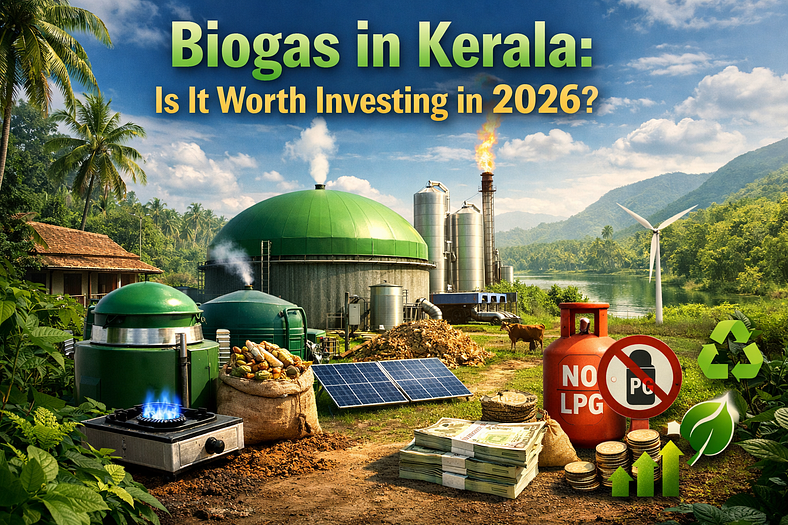
With rising fuel costs, strict waste-management rules, and a growing focus on sustainability, biogas in Kerala is gaining serious attention. From households to hotels and industries, many are asking one big question: Is investing in biogas in Kerala really worth it in 2026?
Let’s break it down clearly — costs, benefits, challenges, and future potential.
What Is Biogas and Why Kerala Needs It
Biogas is a renewable energy produced from organic waste such as food waste, animal dung, and agricultural residue. Kerala, with its high population density and large volume of biodegradable waste, is an ideal state for biogas adoption.
Waste disposal issues, landfill shortages, and environmental concerns make biogas in Kerala not just an option — but a necessity.
Current Scenario of Biogas in Kerala
Kerala has already taken strong steps toward renewable energy and decentralized waste management. Local Self Government bodies, housing societies, hotels, and institutions are increasingly installing biogas plants.
Key drivers:
- Ban on food waste dumping
- Rising LPG and electricity prices
- Government support and subsidies
- Awareness about sustainable living
Cost of Investing in Biogas in Kerala (2026 Outlook)
The cost of a biogas plant depends on size and usage:
- Household biogas plant: ₹25,000 — ₹80,000
- Apartment / commercial setup: ₹1.5 lakh — ₹10 lakh
- Industrial biogas plants: ₹10 lakh and above
Although the initial investment may seem high, the long-term savings make biogas in Kerala financially attractive.
Return on Investment (ROI)
One of the biggest advantages of biogas is consistent savings.
- Reduced LPG or electricity bills
- Lower waste disposal costs
- Free organic manure as a by-product
- ROI typically achieved in 2–4 years
In 2026, with energy costs expected to rise further, ROI timelines may become even shorter.
Government Support & Subsidies
Kerala offers multiple incentives to promote biogas adoption:
- Subsidies through Local Self Government bodies
- Support from ANERT and Clean Kerala Mission
- Special schemes for apartments, hotels, and institutions
These incentives significantly reduce the upfront cost, making biogas in Kerala a smart investment.
Environmental Benefits
Beyond money, biogas offers massive environmental value:
- Reduces landfill waste
- Cuts greenhouse gas emissions
- Promotes circular economy
- Produces clean, renewable energy
For businesses, biogas also improves ESG and sustainability credentials.
Challenges to Consider
While promising, biogas does come with challenges:
- Proper segregation of organic waste is required
- Regular maintenance is necessary
- Poor design or installation can affect efficiency
Choosing the right technology provider is critical for long-term success.
Future of Biogas in Kerala
Looking ahead to 2026 and beyond:
- Waste-to-energy policies will become stricter
- Energy prices are likely to rise
- Sustainable infrastructure will be mandatory for many sectors
This makes biogas in Kerala not just viable — but future-proof.
Final Verdict: Is Biogas in Kerala Worth Investing in 2026?
Yes — absolutely.
For households, it offers energy independence.
For businesses, it reduces operating costs.
For Kerala, it solves a growing waste crisis.
With government support, strong ROI, and environmental benefits, biogas in Kerala stands out as one of the smartest green investments for 2026.


.jpg)
Comments
Post a Comment