Biogas in Kerala: Role in Circular Economy and Climate Action
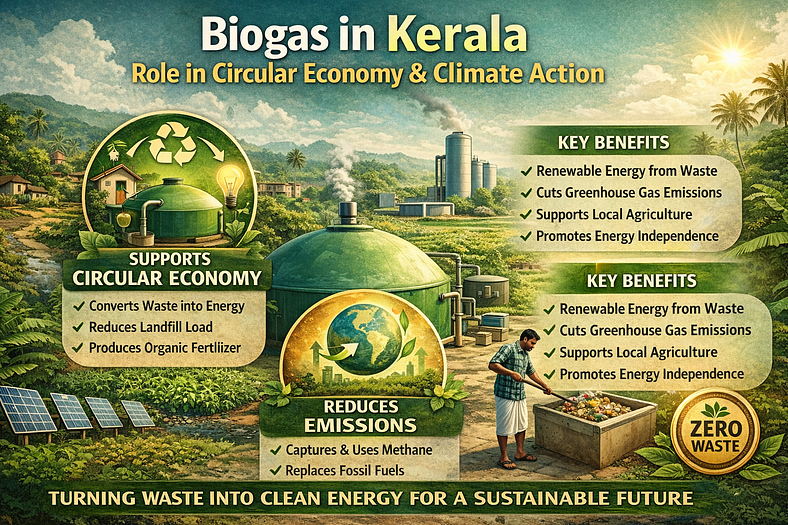
Kerala is facing increasing challenges in waste management, energy demand, and climate change. In this context, biogas in Kerala has emerged as a powerful solution that supports both the circular economy and climate action. By converting organic waste into clean energy, biogas systems help Kerala move toward a greener and more sustainable future.
What Is Biogas?
Biogas is a renewable energy source produced by the anaerobic digestion of organic waste such as food scraps, animal waste, and agricultural residues. The process generates methane-rich gas that can be used for:
- Cooking
- Electricity generation
- Heating
- Powering small industries
The leftover slurry is a nutrient-rich organic manure.
Biogas in Kerala and the Circular Economy
A circular economy focuses on reducing waste, reusing resources, and regenerating natural systems. Biogas in Kerala fits perfectly into this model.
How Biogas Supports Circular Economy
- Converts kitchen and organic waste into energy
- Reduces dependency on landfills and dumping sites
- Produces organic fertilizer as a by-product
- Encourages local energy production and consumption
- Minimizes waste transportation and disposal costs
- Instead of treating waste as a problem, biogas systems turn it into a valuable resource.
Role of Biogas in Climate Action
Reduction in Greenhouse Gas Emissions
Organic waste in landfills releases methane, a gas far more harmful than carbon dioxide. Biogas plants capture and utilize methane, preventing its release into the atmosphere.
Replacement of Fossil Fuels
Biogas replaces LPG, firewood, and other fossil fuels, significantly reducing:
- Carbon emissions
- Indoor air pollution
- Dependence on imported fuels
Why Biogas in Kerala Is Gaining Importance
Kerala has ideal conditions for biogas adoption:
- High organic waste generation
- Dense population and urban waste challenges
- Strong local self-government systems
- Climate-conscious policies and awareness
From households to municipalities, biogas in Kerala is becoming an essential waste-to-energy solution.
Applications of Biogas in Kerala
- Households: Kitchen waste-based biogas plants
- Apartments & Flats: Community biogas systems
- Hotels & Hostels: Large-scale food waste processing
- Municipalities: Organic waste management projects
- Farms: Animal waste-based biogas plants
Government Support for Biogas in Kerala
To promote sustainable energy, the government provides:
- Financial subsidies for domestic biogas plants
- Support through local self-governments
- Technical assistance and awareness programs
- Integration with waste management policies
These initiatives encourage wider adoption of biogas in Kerala.
Environmental Benefits of Biogas in Kerala
- Reduces landfill waste
- Controls foul odor and leachate problems
- Improves soil fertility using organic slurry
- Protects groundwater from contamination
- Supports Kerala’s climate goals
Challenges and Solutions
Challenges:
- Initial installation cost
- Lack of awareness
- Maintenance issues in poorly managed systems
Solutions:
- Proper training and guidance
- Quality plant design and installation
- Regular monitoring and maintenance
- Community participation
Future of Biogas in Kerala
With increasing focus on sustainability and climate action, biogas in Kerala is expected to play a major role in:
- Achieving zero-waste goals
- Reducing carbon footprint
- Promoting decentralized renewable energy
- Strengthening local economies
Conclusion
Biogas in Kerala is more than just an energy source — it is a key driver of the circular economy and climate action. By transforming waste into wealth, biogas systems help Kerala protect the environment, reduce emissions, and build a sustainable future.


Comments
Post a Comment