Opportunities and Challenges of Biogas in Kerala
Introduction
With increasing concerns about waste management and rising fuel costs, biogas in Kerala is emerging as a sustainable and practical energy solution. Kerala produces a significant amount of organic waste daily from households, hotels, markets, and farms. Instead of sending this waste to landfills, biogas technology converts it into clean cooking fuel and organic fertilizer.
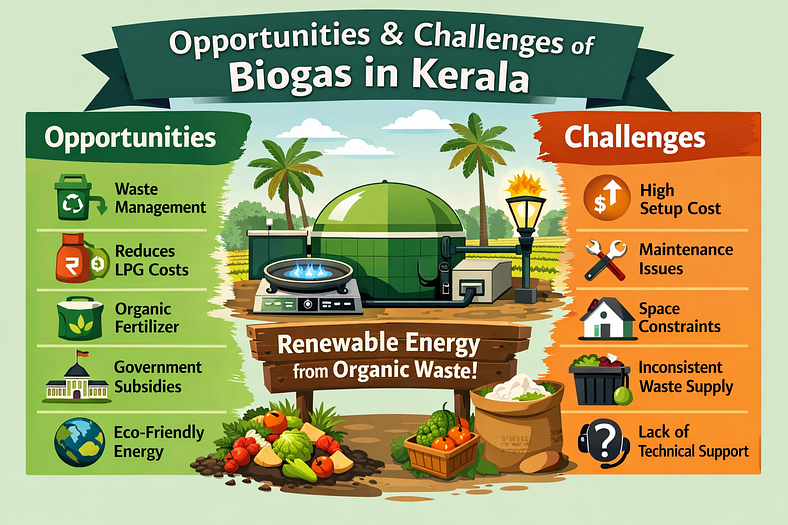
However, while the opportunities are immense, certain challenges still slow down widespread adoption. Let’s explore both sides in detail.
What is Biogas?
Biogas is a renewable energy source produced by the anaerobic digestion of organic waste such as:
- Kitchen waste
- Food waste
- Cow dung
- Agricultural residues
- Poultry waste
The gas produced mainly contains methane, which can be used for cooking, electricity generation, and heating.
In Kerala, biogas systems are commonly installed in homes, apartments, hotels, and farms.
Opportunities of Biogas in Kerala
1. Effective Waste Management Solution
Kerala faces serious waste disposal challenges due to high population density. Biogas in Kerala offers a decentralized waste management solution where waste is processed at the source itself.
This reduces:
- Landfill pressure
- Waste transportation costs
- Environmental pollution
2. Reduction in LPG Dependency
With fluctuating LPG prices, many households are looking for alternatives. Biogas can significantly reduce monthly LPG expenses, especially in homes that generate regular kitchen waste.
For hotels and hostels, this benefit is even more substantial.
3. Government Support & Subsidies
The Kerala government and central agencies promote renewable energy projects. Various subsidy schemes encourage households and farmers to install biogas plants.
Support is often provided for:
- Domestic biogas plants
- Institutional biogas systems
- Community biogas projects
This makes installation more affordable.
4. Organic Fertilizer Production
One of the biggest advantages of biogas in Kerala is the byproduct — slurry. This slurry is a nutrient-rich organic fertilizer that improves soil fertility.
Farmers benefit by:
- Reducing chemical fertilizer use
- Improving crop yield
- Promoting organic farming
5. Environmental Benefits
Biogas helps reduce greenhouse gas emissions. When organic waste decomposes openly, it releases methane into the atmosphere. Biogas plants capture and utilize this methane effectively.
This contributes to:
- Lower carbon footprint
- Cleaner surroundings
- Reduced air pollution
6. Suitable Climate Conditions
Kerala’s warm and humid climate supports efficient anaerobic digestion, making it ideal for biogas production throughout the year.
Challenges of Biogas in Kerala
1. Initial Installation Cost
Although subsidies are available, the initial setup cost can be a barrier for some households.
Costs depend on:
- Plant size
- Type of technology
- Installation requirements
Small domestic plants are affordable, but larger systems require higher investment.
2. Maintenance and Awareness Issues
Many users are unaware of proper maintenance practices. Poor management can lead to:
- Gas leakage
- Low gas production
- Blockages
Proper training and awareness programs are essential.
3. Space Constraints
In urban areas, especially apartments, installing a biogas plant can be difficult due to limited space.
However, compact and portable biogas models are slowly addressing this issue.
4. Inconsistent Waste Feeding
Biogas plants require regular feeding of organic waste. If households do not generate enough waste consistently, gas production may fluctuate.
Hotels and farms usually do not face this issue.
5. Technical Support Limitations
In some areas, technical service support may not be readily available. Lack of timely servicing can discourage users.
Future of Biogas in Kerala
The future of biogas in Kerala looks promising due to:
- Increasing environmental awareness
- Government push for renewable energy
- Rising LPG prices
- Growing demand for organic farming
With better awareness, technological improvements, and stronger policy support, biogas can become a mainstream energy solution in Kerala.
Conclusion
Biogas in Kerala presents a powerful opportunity to tackle waste management problems while generating clean energy. It reduces fuel costs, supports organic farming, and protects the environment.
However, challenges such as initial cost, maintenance issues, and space limitations must be addressed through education, innovation, and government support.
With proper implementation, biogas can play a key role in building a sustainable and eco-friendly Kerala.


Comments
Post a Comment