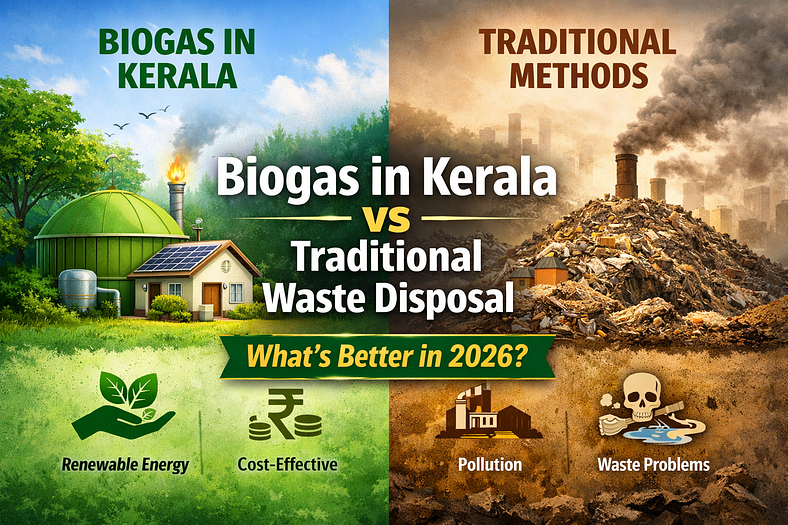
Biogas in Kerala vs Traditional Waste Disposal Methods: What’s Better in 2026?
Introduction
Waste management has become a growing concern across households, businesses, and municipalities. With increasing environmental awareness and stricter regulations, people are now actively looking for sustainable alternatives. One solution that is gaining momentum is biogas in Kerala — a system that converts organic waste into usable energy.
But how does it compare to traditional waste disposal methods like landfills and incineration? Let’s explore which option is better in 2026.
What is Biogas in Kerala?
Biogas in Kerala refers to the process of converting organic waste — such as food scraps, vegetable peels, and agricultural waste — into methane-rich gas through anaerobic digestion.
This gas can be used for:
- Cooking 🔥
- Electricity generation ⚡
- Heating purposes ♨️
Additionally, the by-product (slurry) can be used as organic fertilizer 🌱
Traditional Waste Disposal Methods in Kerala
1. Landfills
The most common method where waste is dumped in large open areas.
2. Incineration
Burning waste at high temperatures to reduce volume.
3. Open Dumping
Unregulated waste disposal still seen in some areas.
Biogas in Kerala vs Traditional Methods: Key Comparison
1. Environmental Impact
Biogas in Kerala
- Reduces greenhouse gas emissions
- Minimizes landfill usage
- Produces eco-friendly fertilizer
Traditional Methods
- Landfills release methane (harmful greenhouse gas)
- Incineration causes air pollution
- Open dumping leads to soil and water contamination
👉 Winner: Biogas in Kerala
2. Cost Efficiency
Biogas in Kerala
- Initial setup cost required
- Long-term savings on LPG and electricity
- Government subsidies available
Traditional Methods
- Continuous waste transport and management costs
- No direct return or savings
👉 Winner: Biogas in Kerala (long-term)
3. Waste Reduction Efficiency
Biogas in Kerala
- Converts up to 80–90% of organic waste into energy
Traditional Methods
- Landfills accumulate waste
- Incineration reduces volume but creates ash
👉 Winner: Biogas in Kerala
4. Energy Generation
Biogas in Kerala
- Produces renewable energy for daily use
Traditional Methods
- No usable energy (except limited waste-to-energy plants)
👉 Winner: Biogas in Kerala
5. Ease of Implementation
- Requires installation and maintenance
- Needs segregation of organic waste
Traditional Methods
- Easier (no effort from households)
👉 Winner: Traditional Methods (short-term convenience)
Why Biogas in Kerala is the Better Choice in 2026
Kerala is moving towards sustainable and decentralized waste management systems. With increasing awareness and support from local bodies, biogas in Kerala is becoming a practical solution for:
- Households 🏠
- Apartments 🏢
- Hotels & restaurants 🍽️
- Farms 🌾
The ability to turn waste into energy makes it both an eco-friendly and economically smart choice.
Challenges of Biogas in Kerala
While biogas systems offer multiple benefits, there are still some challenges:
- Initial installation cost
- Lack of awareness in rural areas
- Maintenance requirements
- Need for proper waste segregation
However, these challenges are gradually being addressed through government initiatives and private sector involvement.
Future of Biogas in Kerala
By 2026 and beyond, biogas in Kerala is expected to grow rapidly due to:
- Increased environmental regulations
- Rising fuel costs
- Government incentives and subsidies
- Shift towards sustainable living
Biogas plants are likely to become a standard feature in modern homes and commercial establishments.
Conclusion
When comparing biogas in Kerala vs traditional waste disposal methods, the answer is clear. While traditional methods may offer short-term convenience, they come with long-term environmental and economic costs.
On the other hand, biogas in Kerala provides a sustainable, cost-effective, and eco-friendly solution that benefits both individuals and the environment.


Comments
Post a Comment