Biogas in Thrissur: The Silent Energy Revolution Transforming Kerala’s Green Future
Introduction: Why Thrissur is Becoming a Hidden Hub for Biogas Innovation
When people talk about renewable energy in Kerala, solar energy often steals the spotlight. But quietly, a powerful green revolution is growing in the heart of Thrissur — and that is biogas technology.
Unlike mainstream discussions, biogas in Thrissur is not just about household cooking fuel anymore. It is evolving into a waste-to-energy ecosystem, reshaping how hotels, homes, farms, and institutions manage organic waste.
What Makes Biogas in Thrissur Unique? (Rare Insight)
Thrissur has a special advantage that most districts don’t:
- High density of hotels and wedding halls
- Strong agricultural base
- Large volume of organic food waste
- Increasing awareness about waste segregation
This combination makes Thrissur a perfect micro-ecosystem for decentralized biogas plants.
Instead of dumping waste in landfills, many local units are now converting it into:
- Cooking gas
- Organic slurry fertilizer
- Electricity (in advanced systems)
The Hidden Biogas Network You Don’t Hear About
Most people assume biogas is only used in villages or government projects. But in Thrissur, a silent private-sector network is growing:
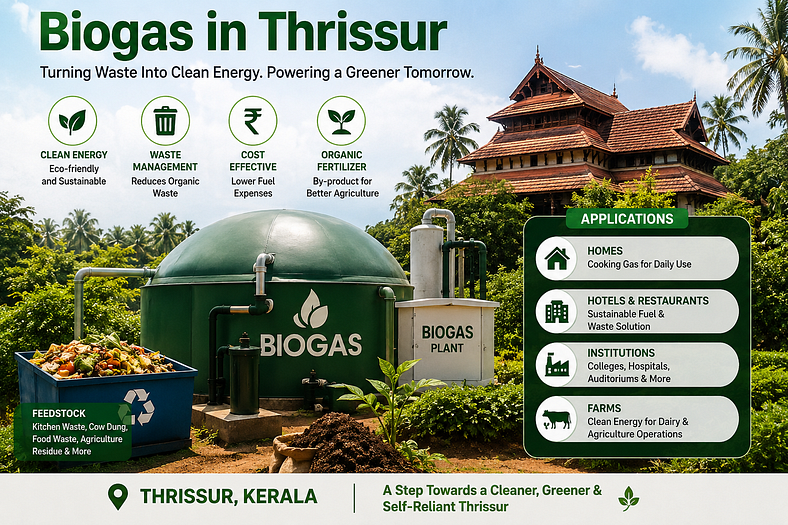
1. Small Household Biogas Units
Families in semi-urban areas are installing compact digesters that convert kitchen waste into daily cooking fuel.
2. Hotel-Based Biogas Systems
Restaurants and catering units are increasingly adopting biogas plants to reduce LPG costs and manage waste legally.
3. Institutional Biogas Plants
Colleges, hospitals, and auditoriums are integrating biogas systems for sustainability compliance.
4. Farm-Integrated Systems
Dairy farms are combining cow dung + food waste to generate continuous gas supply.
Why Biogas is Becoming Important in Thrissur Now
Several unseen factors are pushing this shift:
- Rising LPG prices
- Strict waste management regulations
- Kerala’s green energy push
- Smart city waste initiatives
- Growing ESG compliance awareness among businesses
In simple terms, biogas is becoming both an economic and legal necessity, not just an environmental choice.
Benefits of Biogas Systems in Thrissur
🌱 Environmental Benefits
- Reduces landfill waste
- Cuts methane emissions
- Produces organic fertilizer
💰 Economic Benefits
- Reduces LPG dependency
- Low maintenance cost after installation
- Long-term savings for businesses
🏡 Social Benefits
- Cleaner neighborhoods
- Better waste discipline
- Supports green employment
Challenges Still Facing Biogas Adoption
Despite growth, Thrissur still faces some barriers:
- Lack of technical awareness in rural areas
- Maintenance hesitation
- Initial installation cost concerns
- Space limitations in urban homes
However, newer compact designs are solving most of these issues.
Future of Biogas in Thrissur (2026 and Beyond)
The future is shifting toward:
- Smart biogas systems with monitoring sensors
- Community-level biogas hubs
- Integration with municipal waste plants
- Hybrid systems (solar + biogas energy models)
Thrissur is slowly moving toward becoming a model district for decentralized renewable energy in Kerala.
Conclusion
Biogas in Thrissur is no longer a hidden concept — it is becoming a practical energy solution for real-world waste problems.
From households to hotels, the shift is clear:
Waste is no longer waste — it is energy.


Comments
Post a Comment